
A recurring pattern has been observed in web security research: newly published papers reporting “99% accuracy” are frequently met with widespread acceptance, with their findings widely shared, sparking interest in turning them into products. However, security operates as a dynamic, adversarial system rather than a static leaderboard, with attackers continuously probing for weaknesses that existing metrics fail to capture. This phenomenon has been characterized as a blind spot in the web payload search space, as discussed in “Can AI Detect Web Attacks Better Than Rules?” The underlying argument, though simple, carries considerable weight:
The focus on accuracy metrics, while valuable, can obscure critical gaps in real-world security systems. A balance between accuracy and operational sustainability is essential; chasing maximal detection rates without considering business continuity can introduce friction that undermines security goals. This perspective is grounded in WAMM (Web Attack Multi-classification Model), a recent research study on web payload classification and WAF evaluation, which is particularly useful because it demonstrates both what accuracy measures and what it can obscure. Effective cybersecurity must function as a practical tool that supports business operations, rather than as an isolated optimization target.
The Accuracy Trap: When One Number Lies by Omission
Accuracy addresses only one question: out of all requests, how many were labeled correctly? This framing seems reasonable until the actual composition of web traffic is considered. Legitimate traffic makes up the vast majority, while malicious traffic is rare and fragmented across distinct categories (LIZ, CDAZ, MRAZ, and the expanding BUAZ). This distribution creates a counterintuitive outcome: a detector that labels everything as legitimate would achieve a very high accuracy, and while this satisfies accuracy benchmarks, it produces terrible security. This goes to show that accuracy cannot stand alone.
False Positives vs False Negatives
Security controls encounter two distinct failure modes in production:
False Positives (FP): “Blocking good users”
In the WAMM study, the authors define false positives as benign requests misclassified as attacks. In practice, this translates to a WAF or detector blocking normal behavior such as checkout flows, logins, APIs, payment callbacks, and customer searches.
In production, false positives do not just worsen user experience, they create revenue loss, support storms, and diminished confidence in security tooling. Teams responding to alert fatigue often disable protections entirely. Therefore, a high-accuracy system can still be unusable if its false positives are operationally intolerable.
False Negatives (FN): “Missing real attacks”
A false negative is when an attack is labeled as normal, effectively placing it in the gray area, a concept defined in a previous blog post as the space where real attacks slip through a WAF or detector undetected.
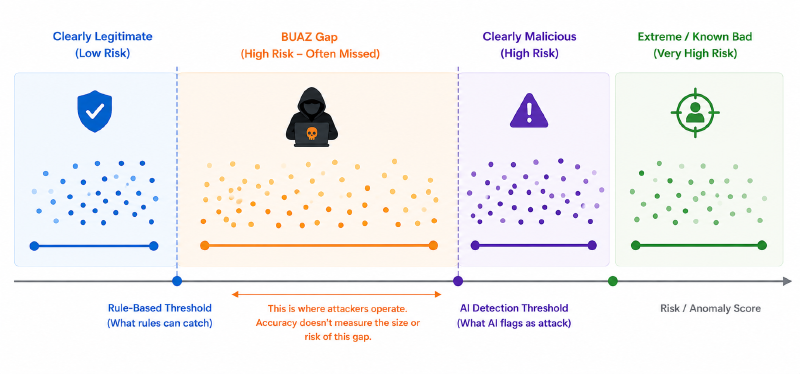
False negatives are worse than what metrics might suggest, because attackers do not need to win often, just once. In WAF contexts, attackers intentionally craft payloads to evade both rule-based detection and AI confidence thresholds, landing in what is known as the Behavioral and Unknown Attack Zone (BUAZ). This decision gap between rule certainty and model certainty is where modern evasion thrives and continuously expands.
Classification Performance Beyond Single-Metric Evaluation
The WAMM paper demonstrates how high accuracy becomes achievable under specific conditions, while also revealing performance degradation under noise, augmentation, and class-level evaluation.
XGBoost achieved 99.59% accuracy with microsecond-level inference, which is an attractive profile for inline WAF environments where latency is critical. Yet the same paper reports that this configuration produces a macro-averaged F1-score of 86.07%, a gap that triggers immediate scrutiny. Macro F1-score treats each attack class equally rather than weighting by frequency, and the gap between 99.59% accuracy and 86.07% macro F1 raises the question: which attack types are being missed or mislabeled?
The paper further demonstrates that deep learning models degrade sharply under noisy augmentation (synthetic or altered examples that introduce distribution shift). This reinforces a critical point: performance in controlled settings often does not persist in production environments, meaning that high accuracy can coexist with fragile security.
Questions Accuracy Alone Can not Answer
Security differs fundamentally from academic benchmarks because attackers do not behave like test data. Rather than generating random malicious traffic sampled from your training set, attackers deliberately craft payloads to exploit the gaps in your defenses, specifically the blind spots that have not been evaluated (BUAZ), as illustrated in Figure 1.
Therefore, when a paper reports high accuracy, critical questions should be answered:
- Accuracy on what distribution?
- How does performance degrade under drift, as applications evolve and traffic changes?
- How does performance degrade under evasion, when attackers mutate payloads intentionally?
- What is the false-positive budget? What business impact is acceptable?
- Which classes fail most often: rare attacks, high-cost attacks, attacks in the gray zone?
A system that performs well on static, clean data can fail catastrophically once deployed, where traffic drifts, attackers evolve their techniques, and rare attacks carry outsized cost. Thus, without explicit answers to these questions, the accuracy merely acts as a measurement artifact and does not reflect how secure the system actually is.
A Framework for Production-Ready Evaluation
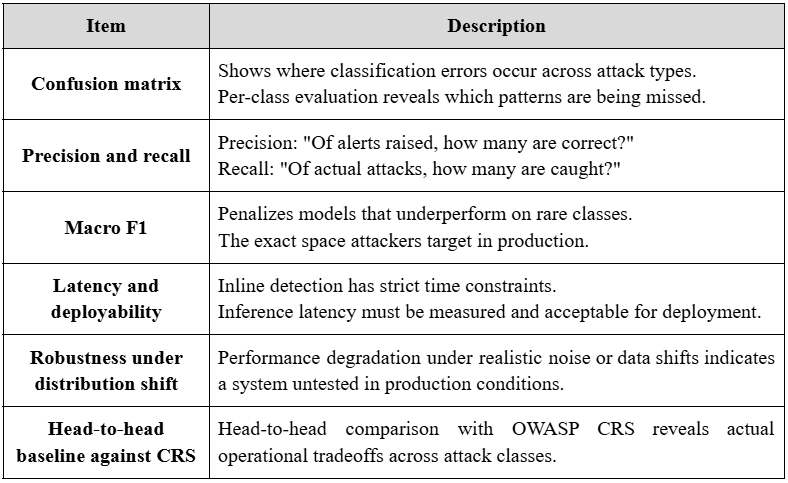
Detection results that translate into real protection require evaluation beyond accuracy. Table 1 shows the metrics that should be assessed:
Conclusion and Recommendation
In security, accuracy is often used as a comfort metric, just a number that provides false reassurance. When high accuracy is reported, the question becomes: where does the system fail, and can attackers exploit these failures? This does not mean accuracy is useless; it simply cannot stand alone. A high-accuracy system can still be unusable and unsafe. Security-grade evaluation must account for:
- Class-level performance: How well detection performs across each attack type.
- Latency budgets: The acceptable latency constraints for a given deployment.
- Drift behavior: How system performance changes as payload characteristics evolve.
- Adversarial robustness: How well the system maintains effectiveness when attackers intentionally craft evasive payloads.
Effective security detection should prioritize resilience over a single accuracy metric.