
Built on the assumption that an organization’s assets are fully known, traditional security programs rest on a premise that is fast becoming obsolete.
Traditional vulnerability management is effective when a reasonably complete asset inventory exists. Known servers, web applications, software, and findings are scanned, checked, patched and reported. Modern environments, however, are no longer neat, static, or fully visible. They span cloud platforms, APIs, SaaS tools, development environments, third-party services, legacy infrastructure, and temporary systems that were never intended to remain in use as long as they have.
Recent guidance from the United Kingdom (UK) National Cyber Security Centre (NCSC) describes External Attack Surface Management (EASM) as an attacker-perspective capability focused on discovering and continuously monitoring internet-accessible assets. This focus exists because vulnerability management requires visibility into what is actually exposed. The same guidance notes that EASM can surface issues beyond classic Common Vulnerabilities and Exposures (CVEs), including exposed services, Domain Name System (DNS) misconfigurations, email weaknesses, and services intended to remain internal.1
Depth Without Breadth
An uncomfortable truth follows from this: vulnerability scanners are generally strong on depth but weak on breadth. Known assets are examined thoroughly, but scanners cannot reliably reveal what has been missed, what has been forgotten, what was deployed outside standard process, or what has become exposed following an infrastructure change. This is not a minor operational gap; it is a structural blind spot.
The NCSC explicitly distinguishes vulnerability scanning from EASM, describing EASM as providing automated discovery of external assets from an outside-in perspective, which allows defenders to see what attackers can see. Regular monitoring is essential, since external exposure changes constantly and the time between exposure and discovery must be minimized for vulnerability management to succeed.1
The core problem is that security teams typically begin with the wrong priority. Instead of asking “What vulnerabilities exist on our known systems?”, they should first be asking “What exposed assets are we completely failing to see?”
The API and Cloud Dimension
This distinction becomes even more significant in API-heavy and cloud-first environments. OWASP’s API Security Top 10 warns that APIs expose a greater number of endpoints than traditional web applications and identifies improper inventory management as a major risk. Accurate inventories of hosts and deployed API versions are described as essential to avoiding deprecated versions and exposed debug endpoints.2
Now, the modern problem is not only whether unpatched systems exist; it is also whether systems exist that no one is patching, because no one is aware they exist.
Where Attack Surface Management Fits
This is the point at which Attack Surface Management (ASM) changes the conversation. The NCSC defines EASM as a subset of ASM concerned with internet-accessible assets and emphasizes that it provides defenders with visibility of online systems equal to or better than that of potential attackers. Instead of treating security as a static checklist for known systems, EASM introduces an end-to-end operational framework, as seen in Figure 1. By driving continuous asset discovery upstream, EASM provides the context needed to prioritize, test, and mitigate risks across uninventoried infrastructure.1
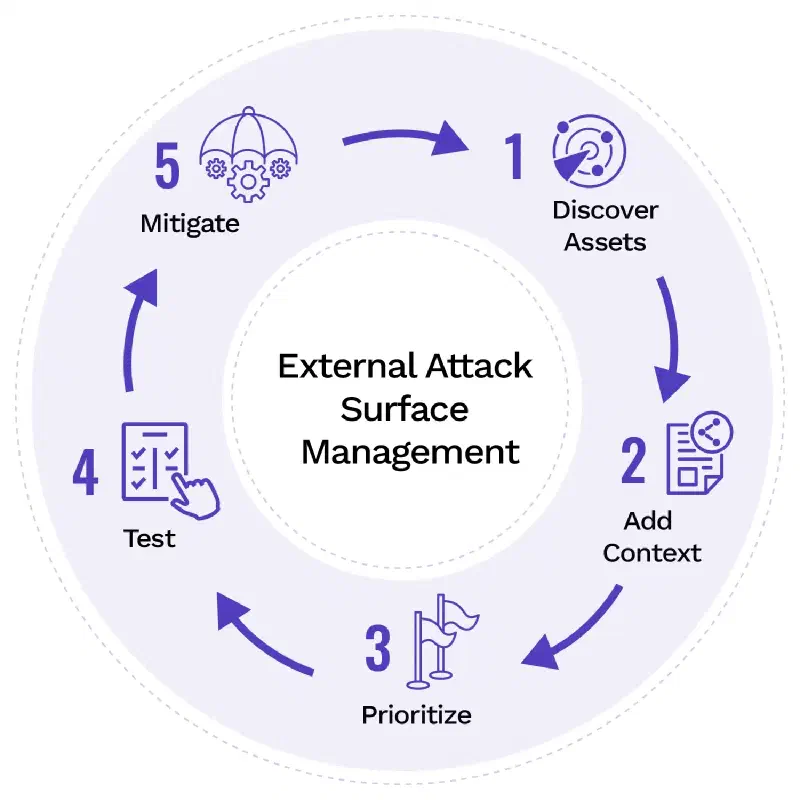
This is not a marketing claim. It is presented as a necessary correction to an outdated operating model.
A recent state-of-the-art paper on ASM argues that increasing reliance on cloud services and third-party hosted resources has expanded the relevant attack surface well beyond what traditional internal inventories capture. The paper also highlights a limitation frequently underestimated by security teams: passive monitoring misses assets that are not actively communicating, while active network scanning misses assets that do not respond, or are not operational, at the time of the scan. Combining multiple data sources is presented as necessary, since no single collection method offers complete visibility.3
This finding should give security leaders some pause. It suggests that incomplete visibility is not simply a tooling limitation, it is an architectural reality of modern environments. If a service is exposed to the internet, it is almost certainly already being scanned by others. The NCSC states plainly that internet-exposed services are scanned daily by internet-wide scanning services, researchers, and, potentially, malicious actors.1 Unlike defenders, attackers do not require access to an organization’s Configuration Management DataBase (CMDB) to find these services.
Why High Scan Coverage Is No Longer Enough
High vulnerability scan coverage often creates a false sense of security, masking critical exposures that exist just beyond the perimeter of known assets. Consider a common enterprise scenario:
A mature enterprise has a strong vulnerability management program: production servers are scanned regularly, critical findings are escalated, and patching is tracked.
During a rushed cloud migration, a development team deploys a temporary public API endpoint with weak controls, no assigned owner, and no asset-inventory registration. The project moves on, but the API remains live.
Because the asset is unknown, it is never scanned or monitored. An attacker discovers it through routine internet-wide scanning, exploits it, and uses it to pivot deeper into the environment.
The incident is initially described as a “visibility issue.” More accurately, the breach occurred outside the scope of the security program because the asset was never known to exist.
This illustrates the central problem: high scan coverage of known assets can still leave significant exposure among unknown assets.
Research on network attack surface mapping describes the core task as detecting and categorizing exposed network services through which an attacker might attempt malicious activity. A 2024 study of the external attack surface of major European enterprises further demonstrates that large organizations’ external exposure can be systematically measured and analyzed from the outside.4 Together, these findings reinforce a simple point: the external attack surface is real, dynamic, and, for many organizations, larger than existing inventories suggest.
Complementary Disciplines
None of this discussion renders vulnerability scanning obsolete. It indicates, rather, that vulnerability scanning is insufficient when used alone. Vulnerability Management and ASM should not compete. They address different dimensions of the same problem.
- Vulnerability Management provides depth: it identifies what is wrong within assets that are already known and assessed.
- ASM provides breadth: it enables the discovery of assets, exposures, services, and pathways that may never have entered the official visibility model in the first place.
The NCSC’s guidance explicitly frames EASM as supportive of vulnerability management, rather than as a replacement for it, and a mature security program requires both.1
Conclusion and Recommendations
To bridge the gap between known assets and modern security realities, organizations should focus on three strategic priorities:
- Asset discovery should be moved from a periodic governance activity to a continuous security function, with external discovery treated as routine, automated operational telemetry rather than an annual cleanup exercise, consistent with the NCSC’s emphasis on continuous monitoring and frequent refresh as key benefits of EASM.1
- APIs, cloud resources, and temporary development infrastructure should be treated as first-class elements of the attack surface, since guidance from OWASP demonstrates that undocumented and poorly inventoried APIs create genuine security risk as versions, endpoints, and ownership drift over time.2
- ASM findings, in turn, should be integrated into existing vulnerability and exposure workflows, with the objective not of producing another dashboard but of reducing the time between new exposure, discovery, validation, and mitigation, which is a logic consistent with the NCSC’s recommendation to incorporate EASM into the broader vulnerability management regime.1
Taken together, these priorities point to a single strategic takeaway: if a security program begins with scanning but not with discovery, then risk is likely being measured against an incomplete map.
“In modern security, the greatest risk is often not the vulnerability that went unpatched, but the asset whose existence was never known.”
National Cyber Security Centre. (2025, September 18). External attack surface management (EASM) buyer’s guide. https://www.ncsc.gov.uk/guidance/external-attack-surface-management-buyers-guide
OWASP API Security Project. (2023). OWASP Top 10 API Security Risks – 2023. https://owasp.org/API-Security/editions/2023/en/0x11-t10/
Husák, M., & Sadlek, L. (2025). Attack surface management: State of the art and operational challenges. In 2025 IEEE 11th International Conference on Network Softwarization (NetSoft). https://doi.org/10.1109/NetSoft64993.2025.11080588
Gelernter, N., Schulmann, H., & Waidner, M. (2024). External attack-surface of modern organizations. In Proceedings of the 19th ACM Asia Conference on Computer and Communications Security (pp. 589–604). https://doi.org/10.1145/3634737.3656295