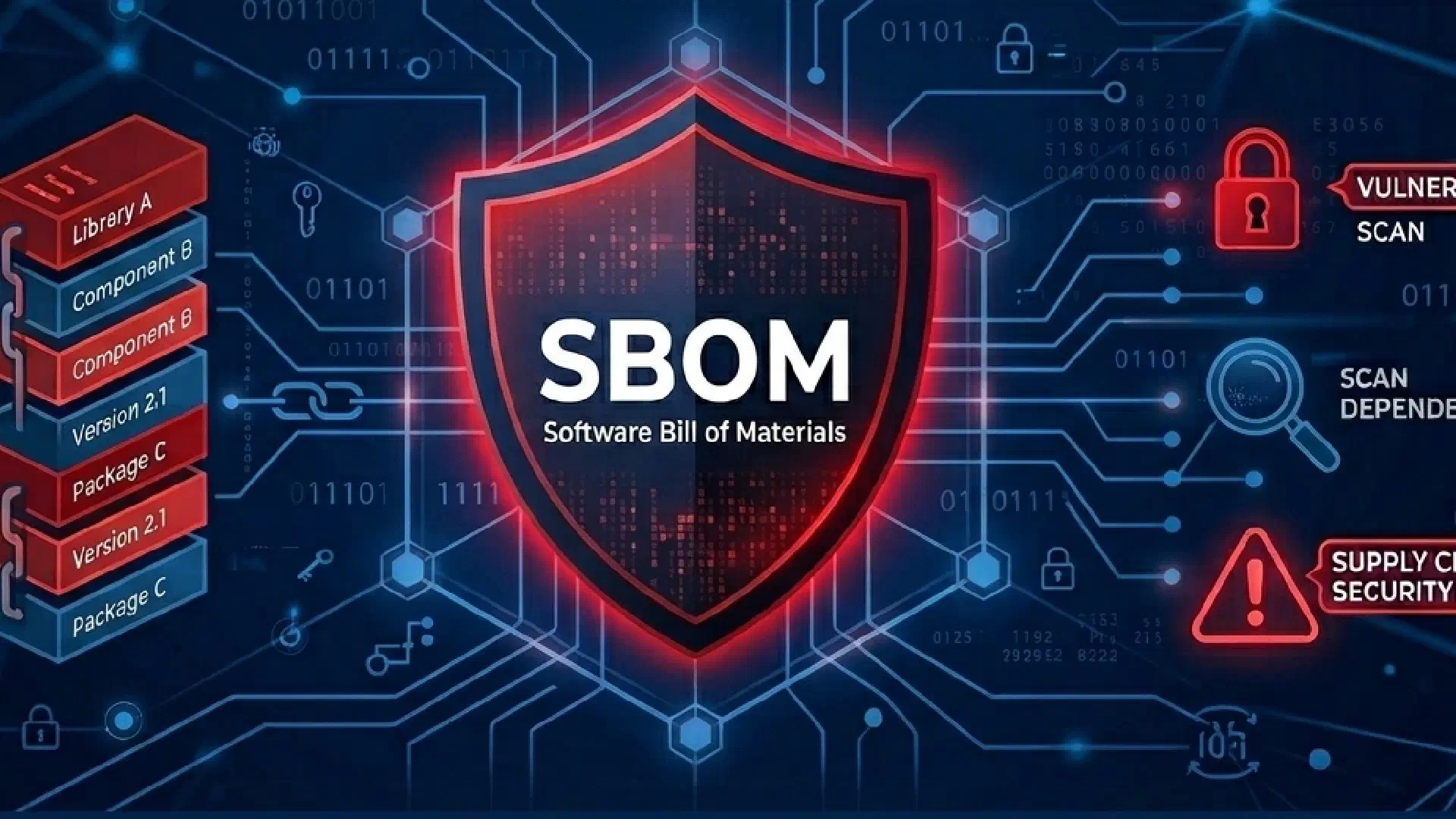
Software is built like a layer cake full of libraries, packages, and hidden dependencies. But when a security crisis hits, do you really know what’s inside your code?
This is where a Software Bill of Materials (SBOM) becomes essential. Much like a food label lists ingredients, an SBOM provides a complete inventory of the components in your software. It empowers developers, security teams, and customers to identify vulnerable libraries, comply with regulations, and respond quickly to incidents.
In this blog, we’ll demystify SBOMs, what they are, why they matter, how to create and use them, and how they’re becoming a cornerstone of software supply chain security.
What is a Software Bill of Materials (SBOM)?
A Software Bill of Materials (SBOM) is a formal, machine-readable inventory that lists all components used in a software product including open-source packages, proprietary libraries, and third-party modules.
Think of it like the ingredient label on packaged food. Just as you need to know what you’re eating, organizations need to know what’s inside their software to evaluate risk, manage vulnerabilities, and ensure compliance.
What does an SBOM typically include?
A standard SBOM captures key metadata for every software component. The table below outlines the essential fields:
| Field | Description |
|---|---|
| Component Name | Name of the library or module (e.g., log4j) |
| Version | Specific version in use (e.g., 2.14.1) |
| Supplier | Author or vendor (e.g., Apache Software Foundation) |
| License | Associated open-source or commercial license (e.g., Apache-2.0) |
| Dependency Type | Direct or transitive (indirect) dependency |
| Hash (optional) | File hash (e.g., SHA-256) for component verification |
SBOMs can also include additional metadata like component origin, digital signatures, and dependency relationships, which are crucial in understanding how deeply a vulnerability may be embedded in your system.
Why SBOMs Matter
In today’s software ecosystem, applications are rarely built from scratch. They’re assembled from dozens, sometimes hundreds, of third-party components. Each one introduces potential vulnerabilities, licensing obligations, and supply chain risks.
When something like Log4Shell hits a critical vulnerability in a widely used Java logging library organizations scramble to answer a simple question: “Are we using this component anywhere in our systems?” If you don’t have an SBOM, answering that question can take hours or even days. With an SBOM? Seconds.
Benefits of SBOMs
SBOMs deliver value far beyond just listing components. The table below highlights the key benefits they bring to your software security practice:
| Benefit | Description |
|---|---|
| Vulnerability Response | Quickly determine exposure to newly disclosed CVEs |
| Transparency | Understand what’s running in your environment |
| Compliance | Meet legal and regulatory obligations (e.g., EO 14028, FDA, EU CRA) |
| Trust Building | Strengthen relationships with customers and auditors |
| Secure-by-Design | Enforce better DevSecOps hygiene across the SDLC |
SBOM vs. SCA: What’s the Difference, and When to Use Each?
While SBOMs provide visibility into what is inside your software, they do not scan for vulnerabilities themselves. That is where Software Composition Analysis (SCA) tools come in. The following table highlights the difference between SBOM and SCA.
| Feature | SBOM | SCA |
|---|---|---|
| Purpose | Lists what’s in your software | Analyzes components for vulnerabilities, licenses |
| Input | Metadata (e.g., manifest files) | Source code, binaries, SBOMs |
| Output | Inventory | Vulnerability reports, license risks |
| Frequency | At build time | Continuous monitoring recommended |
| Examples | Syft, CycloneDX tools | Dependency-Check, Grype |
SCA tools scan your source code, dependencies, and containers to identify known vulnerabilities, outdated packages, and license risks often using the SBOM as input.
If you’re working with open-source components or building in-house applications, SCA is essential for real-time vulnerability management, while SBOM supports compliance, auditability, and supply chain risk reduction.
SBOM Formats and Standards
Just like there are different document formats for contracts (PDF, DOCX, etc.), SBOMs also come in standardized formats to ensure they’re machine-readable, interoperable, and automatable. These standards help organizations share, analyze, and validate SBOMs across diverse toolchains and vendors.
Here are the three most widely used SBOM standards:
1. SPDX (Software Package Data Exchange)
- Developed by the Linux Foundation
- Approved as an international standard (ISO/IEC 5962:2021)
- Captures licensing, versioning, and package relationships
- Widely used in legal compliance and license audits
Example Output: spdx.json, spdx.rdf, spdx.tag
2. CycloneDX
- Created by OWASP, with a focus on application security
- Lightweight, easy-to-parse format for SBOMs
- Supports metadata like vulnerabilities, cryptographic hashes, and dependency graphs
- Integrates well with security tools and CI/CD pipelines
Example Output: cyclonedx.json, cyclonedx.xml
3. SWID Tags (Software Identification Tags)
- An ISO standard (ISO/IEC 19770-2:2015)
- Commonly used in enterprise IT asset management
- Typically found in commercial software products
- Less developer-friendly compared to SPDX and CycloneDX
The following table provides a comparison of SPDX, CycloneDX, and SWID.
| Feature/Format | SPDX | CycloneDX | SWID Tags |
|---|---|---|---|
| Focus Area | Licensing, legal audits | Security & vulnerabilities | IT asset inventory |
| Created By | Linux Foundation | OWASP | ISO/IEC |
| Format Types | JSON, RDF, Tag | JSON, XML | XML |
| Ease of Use | Moderate | High | Low |
| CI/CD Support | Yes | Yes | Limited |
| Use Case | License tracking | DevSecOps integration | Software inventory mgmt |
How SBOMs Are Created
Creating a Software Bill of Materials manually is possible but not practical. Today’s applications may have dozens or hundreds of dependencies, often changing with every build. That’s why automated SBOM generation tools are essential for keeping your SBOM accurate, current, and integrated with the development pipeline.
SBOM Generation Approaches
SBOMs can be generated in different ways depending on the available artifacts and the stage of the software lifecycle. Common approaches include:
- Static Analysis: Scans source code, manifest files such as package.json and pom.xml, and build metadata to identify declared components.
- Binary Analysis: Analyzes compiled applications, containers, or binaries to detect libraries even without access to the source code.
- Runtime Analysis: Observes software behavior at runtime to infer components, although this is less common for SBOM generation and more often used for behavioral monitoring.
Popular SBOM Generation Tools
The table below highlights some of the most popular tools used to generate SBOMs, along with their supported formats and key features.
| Tool | Format Support | Key Features |
|---|---|---|
| Syft (by Anchore) | SPDX, CycloneDX | CLI-based, container and file scanning, integrates with CI/CD |
| Docker | SPDX, CycloneDX | Native docker sbom command (from v20.10.24) |
| GitHub Actions | SPDX | GitHub can auto-generate SBOMs from dependency graphs |
| Microsoft SBOM Tool | SPDX | Official tool used in Azure DevOps pipelines |
Example CLI (Syft):
syft myapp:latest -o cyclonedx-json > sbom.json
Best Practices for SBOM Generation
- Automate in CI/CD: Embed SBOM creation into your build pipeline
- Generate for every release: SBOMs are only useful if they reflect your deployed version
- Include transitive dependencies: Most vulnerabilities hide in indirect packages
- Store SBOMs securely: They may contain sensitive metadata
How to Use SBOMs in Practice
Having an SBOM is just the beginning. The real value comes from how you use it to strengthen security, manage risk, and comply with regulations. Below are key use cases and best practices.
1. Vulnerability Management
Integrate your SBOM with vulnerability scanners (like Grype or Dependency-Check) to:
- Automatically detect if your software contains components with known CVEs
- Track and remediate vulnerabilities faster
- Prioritize risks based on severity and exploitability
2. Compliance & Auditing
SBOMs help meet:
- Regulatory requirements (e.g., U.S. Executive Order 14028, EU CRA, FDA premarket guidance)
- Licensing compliance for open-source software (OSS)
- Customer or partner requests for transparency
3. Third-Party Risk Management
Request SBOMs from vendors and suppliers to:
- Assess exposure to upstream risks
- Ensure they are maintaining secure supply chains
- Validate patching and maintenance claims
4. Incident Response
When a zero-day is announced (e.g., Log4Shell), security teams can:
- Instantly search SBOMs for affected components
- Identify which apps, systems, or clients are impacted
- Respond with speed and precision
Challenges and Pitfalls
While SBOMs are powerful, several challenges must be addressed:
| Challenge | Description |
|---|---|
| SBOM Drift | Code evolves quickly your SBOM must be kept in sync |
| Transitive Dependencies | Vulnerabilities often hide in indirect libraries |
| Tool Fragmentation | Different ecosystems support different SBOM formats |
| False Sense of Security | SBOMs show “what” you use not “how” it behaves or if it’s safe |
Conclusion: SBOM is the New Security Baseline
In the face of growing threats to the software supply chain, SBOMs are becoming a critical pillar of modern DevSecOps. They offer transparency, accountability, and a way to act fast when vulnerabilities emerge.
Key Takeaways:
- SBOMs are like ingredient lists; they tell you exactly what’s inside your software.
- They are mandated or recommended by several regulatory bodies and security standards.
- Tools like Syft and Docker make SBOM generation easy and automatable.
- The real power of SBOMs comes from how you use them: in vulnerability scanning, audits, incident response, and risk management.
It’s not a question of if you’ll need SBOMs it’s when. Start integrating them now to build secure and trusted software.
References
- NTIA. Minimum Elements for an SBOM, 2021. https://www.ntia.doc.gov/files/ntia/publications/sbom_minimum_elements_report.pdf
- White House. Executive Order 14028, 2021. https://www.whitehouse.gov/executive-order-14028/
- OWASP CycloneDX Project. https://cyclonedx.org/
- SPDX by Linux Foundation. https://spdx.dev/
- Anchore Syft. https://github.com/anchore/syft
- Docker SBOM Docs. https://docs.docker.com/engine/sbom