Introduction
Organizations increasingly rely on third-party cybersecurity solutions to strengthen their security posture. However, selecting and integrating these technologies requires more than reviewing product descriptions or feature lists. An independent technical assessment helps evaluate how a solution performs in realistic scenarios, identify its strengths and limitations, and determine how well it fits within an existing security environment.
As part of Cyshield’s cybersecurity feature evaluation and assessment services, a scenario-based approach is applied that combines practical testing, capability analysis, and expert evaluation across areas such as functionality, performance, usability, integration, and overall maturity.
This assessment provides an evaluation of dPhish version 3.4.0, a security awareness and anti-phishing platform. The evaluation covers its phishing simulation, security awareness, email-security emulation, phishing detection and response, and credential exposure monitoring capabilities.
The assessment examines the platform through practical security use cases, highlighting its capabilities, strengths, operational considerations, and areas for further development.
Assessment Scope: This text reflects the capabilities and observations associated with dPhish version 3.4.0 at the time of the assessment. Certain product, compliance, commercial, and deployment information is based on information available or provided during the assessment and may change over time. The report should not be interpreted as a certification, penetration-test report, or guarantee of product performance.
Product and Company Overview
According to company information available during the assessment, dPhish was founded in 2023 in Cairo, Egypt, with subsequent expansion into the United States and Saudi Arabia.
The company provides an anti-phishing platform that brings together phishing simulation, security awareness training, phishing detection and response, email gateway assessment, and credential exposure monitoring.
The platform addresses both the human and technical sides of phishing resilience by combining employee-focused awareness activities with mechanisms for assessing existing email-security controls.
Executive Summary
dPhish provides an integrated set of capabilities intended to strengthen organizational resilience against phishing attacks.
The evaluated version includes phishing campaign simulation, attack emulation, security awareness training, suspicious email reporting and analysis, a customizable Learning Management System (LMS), analytics, and credential exposure monitoring.
A notable capability is controlled email attack emulation, which allows organizations to assess how existing email-security controls respond to representative attack scenarios.
The platform also supports localized awareness content across multiple languages and dialects. The assessment identified strengths in simulation, awareness training, attack emulation, usability, and operational flexibility, while opportunities for further improvement include dashboard customization, classification reliability, technical integration, documentation, and continued compliance maturity.
The evaluated version should be considered complementary to existing email-security technologies rather than a replacement for an inline real-time email-security gateway.
Key Features
dPhish combines several capabilities that support phishing simulation, security awareness, email-security assessment, analytics, and suspicious-email analysis. These capabilities are summarized in Figure 1.
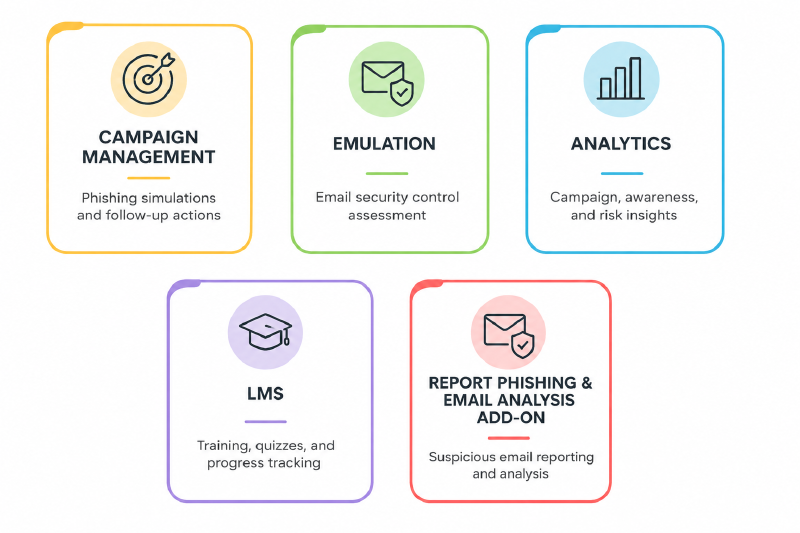
As shown in Figure 1, the platform brings together five main feature areas:
- Campaign Management supports the creation, tracking, and management of phishing simulation campaigns, including post-campaign actions.
- Emulation enables controlled attack scenarios to assess how existing email-security controls respond to representative phishing techniques.
- Analytics provides visibility into campaign results, awareness progress, email-security observations, and risk-related insights.
- LMS delivers phishing-focused training through courses, quizzes, stories, leaderboards, and progress-tracking features.
- Report Phishing & Email Analysis Add-On supports suspicious-email reporting and analysis using behavior-based rules, Indicators of Compromise (IOCs), and automated analysis techniques.
Key Modules
The platform is organized around three main functional modules: Do-Phish, Drill-Phish, and Detect-Phish, as illustrated in Figure 2.

- Do-Phish focuses on phishing simulation and security assessment, enabling organizations to evaluate employee responses and assess selected email-security controls.
- Drill-Phish provides the platform’s learning and awareness capabilities through educational content, quizzes, and other training material.
- Detect-Phish supports suspicious-email analysis and credential exposure monitoring.
Together, these modules combine simulation, training, detection, and monitoring within a unified phishing-resilience environment.
Cost Effectiveness
dPhish consolidates multiple phishing-related capabilities within one platform, including phishing simulation, awareness training, email assessment, reporting, and monitoring.
This consolidation may reduce the operational overhead associated with managing multiple independent tools and provides a centralized environment for phishing-related activities.
Actual cost effectiveness depends on organizational requirements, number of users, selected modules, existing infrastructure, and integration needs.
Capabilities and Benefits
dPhish allows phishing templates to be selected based on factors such as user location, events, and cultural relevance, helping organizations create simulations that better reflect realistic social-engineering scenarios.
The platform also provides awareness content across multiple languages and dialects. This is particularly useful for organizations operating across geographically or culturally diverse environments. Recurring cybersecurity tips further support continuous awareness rather than limiting education to periodic campaigns.
Another significant capability is email-security emulation. The assessed platform included ready-made payloads and scenarios representing techniques such as malicious scripting, HTML smuggling, Punycode-based domain spoofing, credential harvesting, code execution, CVE-related scenarios, suspicious file extensions, password-protected malicious archives, shortcut-file attacks, NTLM hash leakage, persistence, defense evasion, command-and-control, and email-related exfiltration.
These controlled emulations can help organizations evaluate how their existing email-security controls respond to different attack scenarios.
The platform also provides email-status tracking and a Mark as Delivered option for manually confirming delivery where required.
Compliance Considerations
According to information provided by dPhish during the assessment, the company had implemented security controls and was continuing its efforts toward broader compliance requirements.
The company had also undergone third-party risk assessments in Saudi Arabia and was working to address identified security gaps related to governmental and financial-sector requirements.
Because compliance status may change over time, organizations should independently verify current certifications, regulatory alignment, data-processing practices, data-residency requirements, and applicable privacy controls before deployment.
Assessment and Mitigation
The assessment identified several areas that should be considered when evaluating or deploying the platform.
The evaluated version of dPhish does not operate as an inline real-time email-security gateway. Its primary role is phishing simulation, awareness, assessment, reporting, and monitoring. It should therefore complement rather than replace preventive email-security controls.
Email classification accuracy is another consideration. Misclassification can increase investigation effort or reduce confidence in automated analysis. Continued evaluation using diverse benign and malicious datasets can help improve classification reliability.
Processing employee and email-related information also introduces privacy, security, and regulatory considerations that should be reviewed according to organizational requirements.
Additional dashboard customization and broader technical integrations could further improve operational adoption and make collected information easier to incorporate into existing security workflows.
Pricing Plans
At the time of the assessment, dPhish provided subscription-based and MSSP-oriented models as shown in Figure 3.

The subscription-based offering included three levels. Essential included Phishing Simulation, Security Awareness, Policy Management, and Ticketing. Advantage added Advanced Phishing Detection and Response, while Complete additionally included Email Gateway Security Assessment and Dark Web Monitoring.
An MSSP-oriented model was also available to support different service-provider requirements.
Plan availability and included capabilities may change and should be confirmed with the vendor.
Deployment Timeline
The deployment timeline available during the assessment is illustrated in Figure 4, covering both cloud and on-premises deployment approaches.
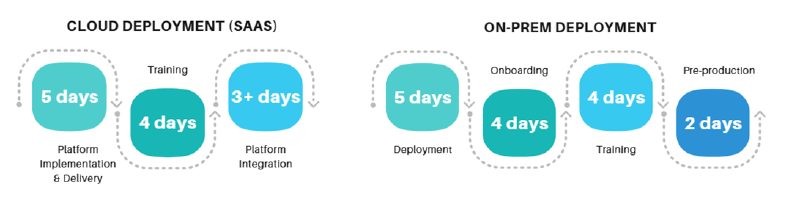
For cloud deployment, the assessed timeline included approximately 5 days for platform implementation and delivery, 4 days for training, and 3 or more days for platform integration.
For on-premises deployment, the timeline included approximately 5 days for deployment, 4 days for onboarding, 4 days for training, and 2 days for pre-production activities.
Actual deployment duration may vary depending on infrastructure, integration complexity, deployment requirements, and organizational readiness.
Comprehensive Analysis
Product Evaluation
The evaluation considered multiple dimensions related to the platform’s functionality, performance, usability, support, vendor maturity, pricing at the time of assessment, and technical integration.
The overall rating for the evaluated features is 3.71 out of 5, reflecting strong performance with potential for further refinement. Table 1 provides a detailed breakdown of the assessment results.
Table 1. dPhish Evaluation Across the Assessed Dimensions
| Evaluation Dimension | Rating | Key Insights |
|---|---|---|
| Functionality | 3.5 / 5 | Provides phishing simulation, email reporting, email gateway assessment, phishing detection, dark web and breach monitoring, ticketing, and related capabilities. Some functions may occasionally experience issues, affecting reliability in specific scenarios. |
| Performance | 4 / 5 | The platform was responsive during the assessment activities, with no significant availability issues observed. Processes operated efficiently during the evaluated scenarios. |
| Ease of Use | 4 / 5 | Provides an intuitive interface and multilingual learning content, including English and Arabic. Additional dashboard customization and interactivity could further improve usability. |
| Customer Support | 4 / 5 | Support was responsive during the assessment and willing to engage directly when required. More comprehensive user guides and technical documentation could reduce dependency on support. |
| Vendor Maturity | 3.5 / 5 | dPhish continues to develop and expand its phishing simulation and security awareness capabilities. Continued platform development, market alignment, and feature enhancement remain important to its maturity. |
| Pricing | 4 / 5 | Multiple subscription tiers and an MSSP-oriented model provide flexibility for organizations with different operational requirements. |
| Technical Integration | 3 / 5 | The platform provides a foundation for email-related integration and reporting. Broader integration with SIEM/SOAR and enterprise security environments may require additional configuration or customization. |
The results indicate generally strong performance across the evaluated dimensions, particularly in performance, ease of use, customer support, and the pricing options assessed at the time.
The comparatively lower technical-integration score highlights an opportunity to strengthen integration with wider enterprise security ecosystems and reduce the configuration required to incorporate phishing-related information into security operations.
Target Audience
dPhish is positioned for organizations seeking to strengthen employee phishing awareness while also evaluating the effectiveness of existing email-security controls.
The main target sectors identified during the assessment are presented in Figure 5.
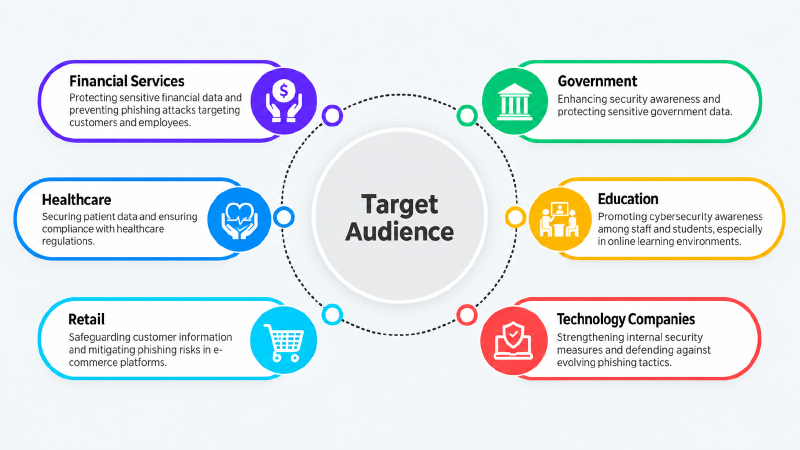
The platform is relevant across sectors such as financial services, government, healthcare, education, retail, and technology.
Within these organizations, relevant users may include cybersecurity teams, IT departments, SOC teams, email-security teams, and HR or training departments responsible for security awareness.
Organizations requiring visibility into potential employee credential exposure may also benefit from the platform’s monitoring capabilities.
Recommended Next Steps
Based on the assessment, organizations considering dPhish should evaluate the platform against their technical, operational, and organizational requirements before deployment.
- Due Diligence: Review dPhish’s technical capabilities, current compliance status, security requirements, and available customer feedback to determine whether the platform is suitable for the organization’s needs.
- Commercial and Service Review: Confirm the current licensing options, included capabilities, and quoted pricing with dPhish. Review the support arrangements and service-level terms against the organization’s requirements.
- Implementation Planning: Develop a structured implementation plan covering the selected deployment model, required integrations, resources, training activities, responsibilities, and key milestones.
Conclusion
dPhish provides a combination of phishing simulation, security awareness, training, suspicious-email analysis, credential exposure monitoring, and email-security assessment capabilities.
A notable aspect of the platform is its ability to address two complementary dimensions of phishing resilience: how employees respond to phishing attempts and how existing technical security controls respond to representative email-based attacks.
The assessment demonstrated generally strong performance across the evaluated areas while identifying opportunities for continued improvement, particularly in classification reliability, dashboard customization, technical integration, documentation, and compliance maturity.
The evaluated version of dPhish should therefore be considered a complementary component within a layered phishing-defense strategy rather than a replacement for preventive email-security technologies.
As phishing techniques continue to evolve, combining realistic simulation, continuous awareness, technical control validation, and measurable improvement can help organizations develop a more adaptive approach to phishing resilience.
Effective phishing resilience requires testing not only the people receiving the message, but also the security controls designed to stop it.