A Security Operations Center (SOC) serves as the central function responsible for monitoring an organization’s security environment, detecting threats, investigating suspicious activity, and coordinating responses to security incidents. With security data generated across endpoints, networks, cloud environments, identities, and applications, SOC teams are expected to turn a constant stream of signals into meaningful security decisions.
SOCs were built to catch threats fast, investigate reliably, and respond with confidence. In theory, it is a clean pipeline: alert, triage, investigate, contain, and report. However in practice, SOCs are drowning. Alerts pile up faster than analysts can process them, investigations require switching between disconnected tools, valuable knowledge remains scattered, and incident response requires multiple teams to coordinate under pressure. The result is delayed investigations, slower containment, greater dependency on senior analysts, and increased operational pressure.
“Modern SOC pressure is not caused by a lack of data, but by the growing effort required to turn that data into timely decisions.”
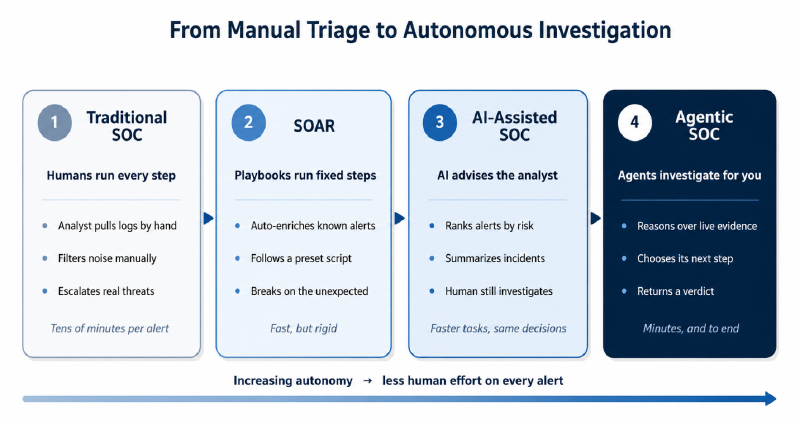
This is where an Agentic SOC approach starts to matter. An Agentic SOC uses Artificial Intelligence (AI) agents to perform and coordinate security operations tasks across the SOC workflow, from alert triage and investigation to response and reporting. These agents can gather context from multiple security tools with scoped permissions, generate and test multiple hypotheses, execute predefined workflows, and produce evidence-based outputs while keeping human analysts involved when judgment or approval is required. This represents the latest stage in a broader maturity curve; from manual triage, through rule-based Security Orchestration, Automation, and Response (SOAR) automation and AI-assisted advisory tools, to agents that reason over live evidence and investigate autonomously, illustrated by Figure 1 below.
Rather than replacing analysts, an Agentic SOC reduces friction across the daily SOC workflow, allowing humans to focus on judgment rather than repetitive tasks. By bringing together context, automating routine activities, and supporting analysts throughout investigations, the overall workflow can become faster and more consistent.
Where Modern SOC Operations Start to Break Down
Modern SOC operations increasingly struggle because of the time and effort required to turn security data into actionable understanding. As security environments become more complex, these challenges become increasingly visible in the day-to-day work of security teams, affecting how analysts detect, investigate, and respond to incidents.
Alert Overload Turns Triage Into Repetitive Work:
Modern SOCs face a constant flood of alerts as detection coverage expands, threat hunting adds new detections, vendors introduce frequent rule updates, and infrastructure telemetry grows. Many alerts are noisy, redundant, or overlapping, while others require correlation across multiple systems before their significance can be understood.
As a result, analysts spend significant time on repetitive triage, validating alerts, confirming known benign behavior, checking correlations, and closing cases with insufficient evidence. Even when similar cases have already been investigated, the same verification steps often have to be repeated. Over time, this creates triage fatigue, slows overall response, and increases the risk of important alerts being overlooked.
“When every alert demands attention, prioritization becomes as important as detection.”
Investigations Lose Time Rebuilding Context:
In the SOC alerts queue, even when an alert is flagged as high priority, investigations often take longer than they should. Incident response is not a straight line from “alert” to “resolved”; it is a web of connected questions that pull analysts across multiple systems, like Security Information and Event Management (SIEM), Endpoint Detection and Response (EDR), Identity and Access Management (IAM) logs, cloud audit trails, ticketing system, threat intel, and more. The timeline has to be pieced together, the users and hosts involved have to be confirmed, what actually changed has to be determined, and whether the suspicious activity is still ongoing has to be verified.
Because the right context is not carried along with the alert, incident context has to be continuously rebuilt, including how these events connect, what is confirmed versus suspected, and what the incident means in the bigger timeline. That lack of continuity creates loops, where each new finding raises the next question, leading to more pivoting, more correlation, and more time spent rebuilding the story. The outcome of this is slower investigations and longer Mean Time to Resolution (MTTR).
Critical SOC Knowledge Does Not Always Scale:
In many SOCs, knowledge exists, but it is scattered across people and documents, rather than being available in one place that can be consistently used by the team. Critical know-how often lives in senior analysts’ heads, passed through tribal learning, or reflected in undocumented workarounds. At the same time, playbooks and detections can become outdated as environments and threats change. When that happens, analysts either have to spend time figuring out what still applies or follow guidance that does not match what is happening today.
Over time, this becomes a bottleneck. New analysts take longer to ramp up, Subject Matter Experts (SMEs) become overloaded with the same questions, and improvements are not spread quickly enough to reduce repeated work.
Incident Response Adds a Coordination Problem:
Incident response is not only about technical skills, it depends on how well the team coordinates, especially when incidents get messy. During an incident, containment decisions, such as isolating endpoints, disabling accounts, or blocking network activity, have to be made while different stakeholders are kept aligned, including Information Technology (IT) operations, application owners, legal or compliance teams, and leadership. Change management rules have to be followed, timelines have to be maintained, and the appropriate points and methods of escalation have to be understood. Usually, multiple parts of the investigation are run in parallel, making clear ownership and communication critical.
As attackers increasingly use AI to adapt faster and make their behavior harder to interpret, the pressure on these decisions is increased. Uncertainty grows, alignment needs to happen quickly, and tradeoffs between speed and safety become harder. If coordination breaks down, even strong technical actions may not be applied correctly. Misunderstandings can slow things down, delayed containment can increase the impact of an attack, and unclear responsibility can lead to duplicated work.
From Fragmented Activities to an Agentic SOC Workflow
The value of an Agentic SOC lies in addressing these challenges as part of a connected workflow rather than treating each activity as an isolated task. By maintaining context across the SOC lifecycle, agentic approaches can reduce the operational friction that slows analysts down and support a more continuous flow from detection and investigation through response and reporting.
Turning Alerts Into Investigation-Ready Cases:
Triage fatigue can be reduced by turning raw alerts into correlated cases with meaningful context. The first-pass analysis is automatically performed by the agentic SOC, where consecutive alerts are deduplicated, alerts are enriched with relevant context, and correlation logic is applied to determine whether activity appears benign, is likely a False Positive (FP), a Benign True Positive (BTP), or is truly suspicious.
A structured case investigation report is then generated, capturing what changed, which entities are involved, and the case outcome. Cases can be closed when activity is confirmed as BTP or an FP, or prioritized and escalated for deeper investigation when additional validation is required. By running these checks consistently across the organization’s security telemetry (spanning endpoints, networks, cloud environments, identities, and applications), repetitive manual verification is reduced and human attention can be focused on cases that require judgment.
Carrying Context Through the Investigation:
MTTR can be reduced by running investigations as structured workflows that guide evidence collection and analysis, rather than requiring analysts to manually correlate data across tools. Once an alert becomes a case, the AI agent executes the investigation playbook end-to-end, building timelines across SIEM and EDR, identifying affected users and hosts, tracking behavioral changes, and mapping potential attack paths.
Throughout the process, investigation context and an analysis trail of the AI agent’s decisions and reasoning are maintained, capturing what was found, what remains unproven, and how each conclusion is supported by evidence. As new signals arrive, context is updated automatically, reducing repetitive analysis and enabling faster movement from alert to validated conclusion and response.
Turning SOC Expertise Into Reusable Workflows:
Knowledge bottlenecks were addressed by turning SOC expertise into reusable workflows. Playbook logic is operationalized by the agentic SOC, so new and senior analysts can work from the same playbook-driven steps, using evidence-based outputs rather than undocumented workarounds.
The workflows can be curated, edited, or extended by analysts based on what they know about their environment, allowing the system to adapt to local context and evolving detection or investigation patterns. This reduces ramp-up time for new hires, prevents SMEs from being overloaded with repetitive questions, and speeds up the propagation of improvements, so SOC benefits from lessons learned immediately rather than months later.
Connecting Investigation With Response and Reporting:
Incident response was made easier to coordinate by standardizing decisions, responsibilities, and stakeholder communication. Containment recommendations are prepared by the AI agent with supporting evidence as well, such as an endpoint isolation recommendation, account disablement justification, or network block suggestion.
Instead of stakeholders receiving partial updates at different times, consistent incident summaries are produced by the AI agent, keeping everyone aligned on what is happening, what actions are recommended, and why. At the same time, the relevant artifacts are automatically collected and structured, audit-ready reports are generated, so analysts are not required to manually stitch notes and screenshots together. This tightens the feedback loop, reduces duplication and handoff delays, and ensures that the final record matches what was actually observed.
What Actually Changes for the SOC
The important shift is not simply that more SOC activities become automated, but that the SOC can operate with greater continuity across the incident lifecycle. An alert can retain its context as it progresses into an investigation, evidence collected during the investigation can remain available when containment decisions are required, and analyst knowledge can be captured in reusable workflows rather than remaining dependent on individual SMEs. Similarly, reporting can be generated as part of the workflow rather than treated as a separate activity after the technical work has been completed.
Within this model, analysts remain responsible for decisions that require security judgment, business awareness, and accountability, while agentic capabilities support the repetitive correlation, evidence collection, context preservation, and workflow execution surrounding those decisions. The approach therefore complements human expertise rather than replacing it, allowing analysts to remain focused on decisions where human judgment is most important.
The way an Agentic SOC is implemented will vary depending on an organization’s existing SOC architecture, operational maturity, and risk requirements. Agentic capabilities can be applied across areas such as alert triage, investigation workflows, evidence collection, response coordination, reporting, rule tuning, and security telemetry gap analysis, with the level of automation determined by the organization’s requirements and operating model.
Ultimately, the value of an Agentic SOC is not measured by how many individual tasks are automated, but by how effectively the incident lifecycle is connected. By preserving context, coordinating workflows, and reducing repetitive operational effort, agentic approaches can help move the SOC from a collection of fragmented activities toward a more connected, adaptive, and evidence-driven operation.
“A more effective SOC is not simply more automated; it is more connected, contextual, and consistent.”